Working amateur radio satellites
Guide · updated June 2026
You can talk through a satellite with a handheld radio and a $40 antenna — or chase DX off a dish. Here’s how the birds work: the orbits, the modes, which ones are flying, and the gear.
The big idea: repeaters in space
An amateur satellite is mostly a repeater you reach by pointing up. It hears you on one band and re-transmits on another (cross-band), so your few watts get a view of half a continent. Some birds are simple FM repeaters; some are transponders that relay a whole slice of spectrum at once; some are digital. You catch the satellite during a pass (the minutes it’s above your horizon), point an antenna, and tune as it moves.
The best part for newcomers: this is Technician-class territory. The easy satellites live on the 2 m and 70 cm bands that an entry-level US license already covers — no HF, no upgrade needed.
Where the birds fly
Altitude decides everything — how long a pass lasts, how much you have to chase it, and how far you can reach.
| Orbit | Altitude | A pass lasts | Example | The deal |
|---|---|---|---|---|
| LEO · low | ~200–1,500 km | ~5–15 min | SO-50, ISS, RS-44 | Where most ham sats live. Fast movers — you track them and tune for Doppler. Several passes a day; a handheld can work them. |
| MEO · medium | ~5,000–20,000 km | up to ~90 min | IO-117 (GreenCube) | Long passes mean big DX in one sitting, with gentler Doppler. (GreenCube proved it — though its status has come and gone; check AMSAT.) |
| GEO · geostationary | ~35,786 km | always up | QO-100 (Es’hail-2) | Parks over one spot on Earth, so it never sets — no tracking, no Doppler. The catch is below. |
About that geostationary bird. QO-100 / Es’hail-2 is the world’s first amateur geostationary transponder — always on, microwave (2.4 GHz up / 10 GHz down), worked with a dish and an LNB. But it sits at 26° East, and its footprint covers Europe, Africa, the Middle East and out to Brazil — not North America. From here it’s something to admire (and listen to via web SDR), not yet to work. A western-hemisphere GEO bird is a long-running community wish.
How they talk
Satellites carry the same modes you’d use on the ground — plus a few data systems built for orbit.
| Mode | What it is | Heard on |
|---|---|---|
| FM voice | One channel, one conversation at a time — literally a repeater in the sky. The easiest way in. | SO-50, ISS |
| SSB / CW | A linear transponder relays a whole band-slice, so many weak-signal QSOs run at once. Usually inverting — tune your uplink up and the downlink moves down, LSB becomes USB. | RS-44, AO-7, FO-29 |
| Packet / APRS | 1200-baud AX.25 data — position beacons and short messages, digipeated from orbit. | ISS (145.825) |
| Digital digipeater | A store-and-forward + real-time data “BBS” worked with a soundcard modem and terminal software. | IO-117 (GreenCube) |
| Telemetry beacons | Health data a sat sends constantly — CW, BPSK, or DUV (“data under voice,” FSK tucked beneath an FM signal). Free apps decode it. | most sats |
| SSTV | Slow-scan TV — still images sent over FM. Decode them with a phone app; no transmit needed. | ISS (special events) |
| DATV | Digital amateur television (DVB-S2), on wideband microwave transponders. | QO-100 wideband |
The one thing that trips everyone up: Doppler. A low-orbit satellite is closing on you at thousands of mph, so its frequency drifts down across a pass (high at acquisition, low at the end). On FM you nudge the dial a few times; on SSB you tune continuously — or let software do it for you (below). Geostationary birds don’t move relative to you, so they have no Doppler at all.
Which ones are flying
The fleet is always changing — sats decay, go quiet, and launch. These are the dependable ones to learn on.
| Satellite | Type | Worth knowing |
|---|---|---|
| SO-50 | FM | The reliable FM workhorse — the first bird most people work. Up 145.850 / down 436.795; 67.0 Hz tone to arm it, 74.4 Hz to talk. |
| ISS | FM + APRS + SSTV | The space station runs a cross-band FM repeater (up 145.990 with a 67.0 Hz tone / down 437.800), an APRS digipeater on 145.825, and occasional SSTV image events on 145.800. |
| RS-44 | SSB / CW linear | A high, strong orbit with long passes — the friendliest first linear-transponder bird. |
| AO-7 | SSB / CW linear | Launched in 1974 and still works whenever it’s in sunlight. Living history you can actually talk through. |
| FO-29 · AO-73 | SSB / CW linear | More linear birds for weak-signal work (availability varies). |
| IO-117 (GreenCube) | MEO digital | The first medium-orbit digital sat — long passes made it a DX magnet. Its operational status has fluctuated, so check before you count on it. |
| QO-100 | GEO microwave | Geostationary, no tracking, no Doppler — but out of reach from North America (see above). |
Always check what’s actually on the air. The single best source is the crowdsourced AMSAT Realtime Satellite Status Page — hams report each bird as they work it, so you can see what’s alive right now. AMSAT is the home org; N2YO’s amateur-satellite tracker shows live positions and pass times.
What you need to listen and talk
Start cheap — the FM birds. A dual-band FM handheld and a small handheld Yagi (an Arrow II or Elk log-periodic) is the classic starter kit: walk outside, point at the pass, talk. It helps enormously to run full-duplex — hearing your own downlink while you transmit — which usually means two radios, or one radio that supports it.
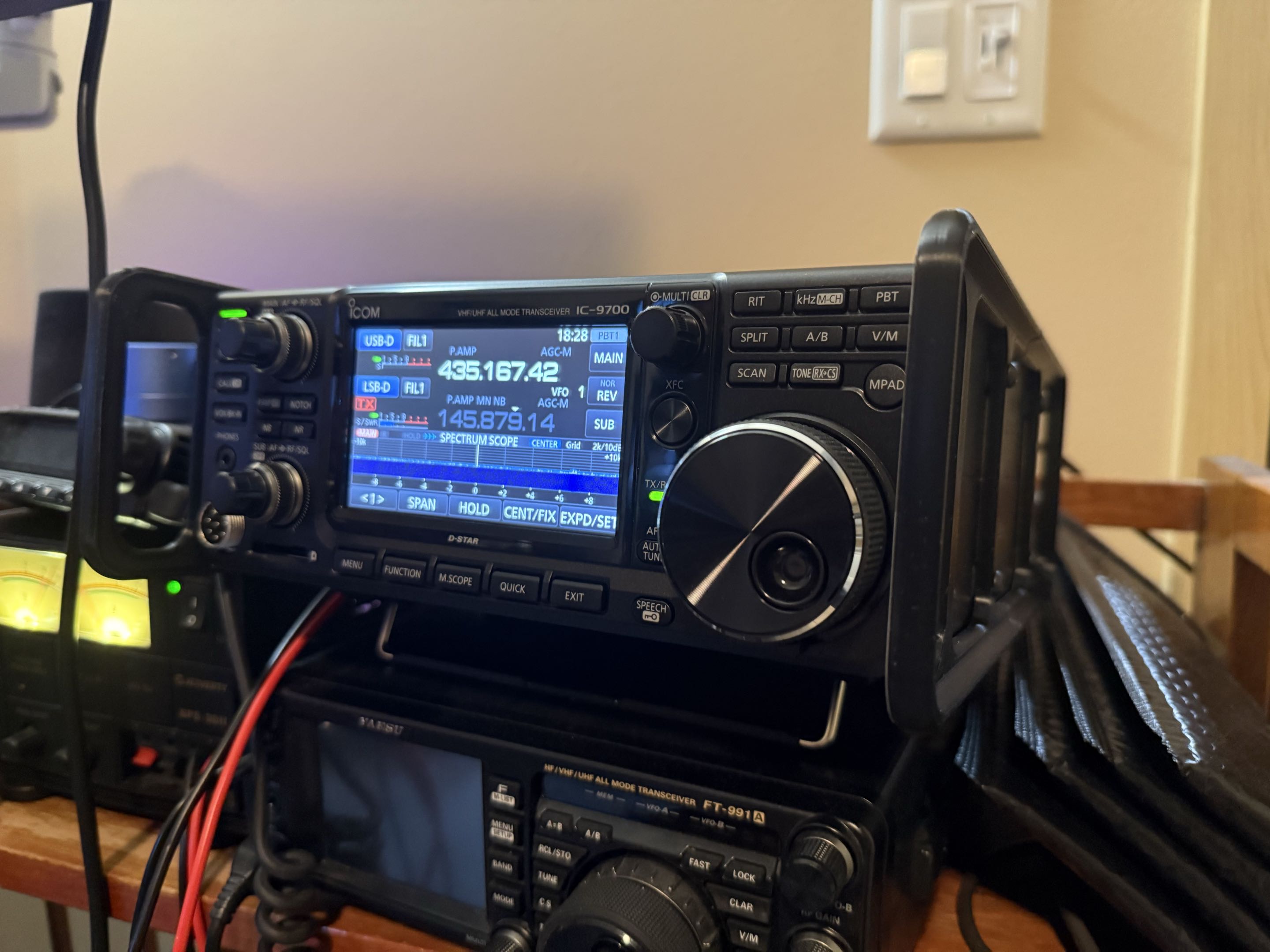
The satellite base — Icom IC-9700. The modern go-to for serious work. It’s an all-mode 2 m / 70 cm / 23 cm transceiver with a real satellite mode: linked uplink/downlink VFOs that track a transponder together (normal and reverse), full duplex so you always hear yourself, and clean computer control so software can ride the Doppler for you. Pair it with crossed Yagis on an az/el rotator and you can work linear and digital birds hands-free.
SDRs. An RTL-SDR is a cheap receive-everything tool — perfect for watching your downlink on a waterfall, decoding telemetry or SSTV, and learning a band before you key up. Airspy and SDRplay units give cleaner ears. For QO-100 the whole receive chain is an SDR: a 10 GHz LNB feeding an SDR for the downlink, with an ADALM-Pluto (plus an amp) for the 2.4 GHz uplink. And an SDR drops straight into SkyRoof, below.
Software: see and hear the birds
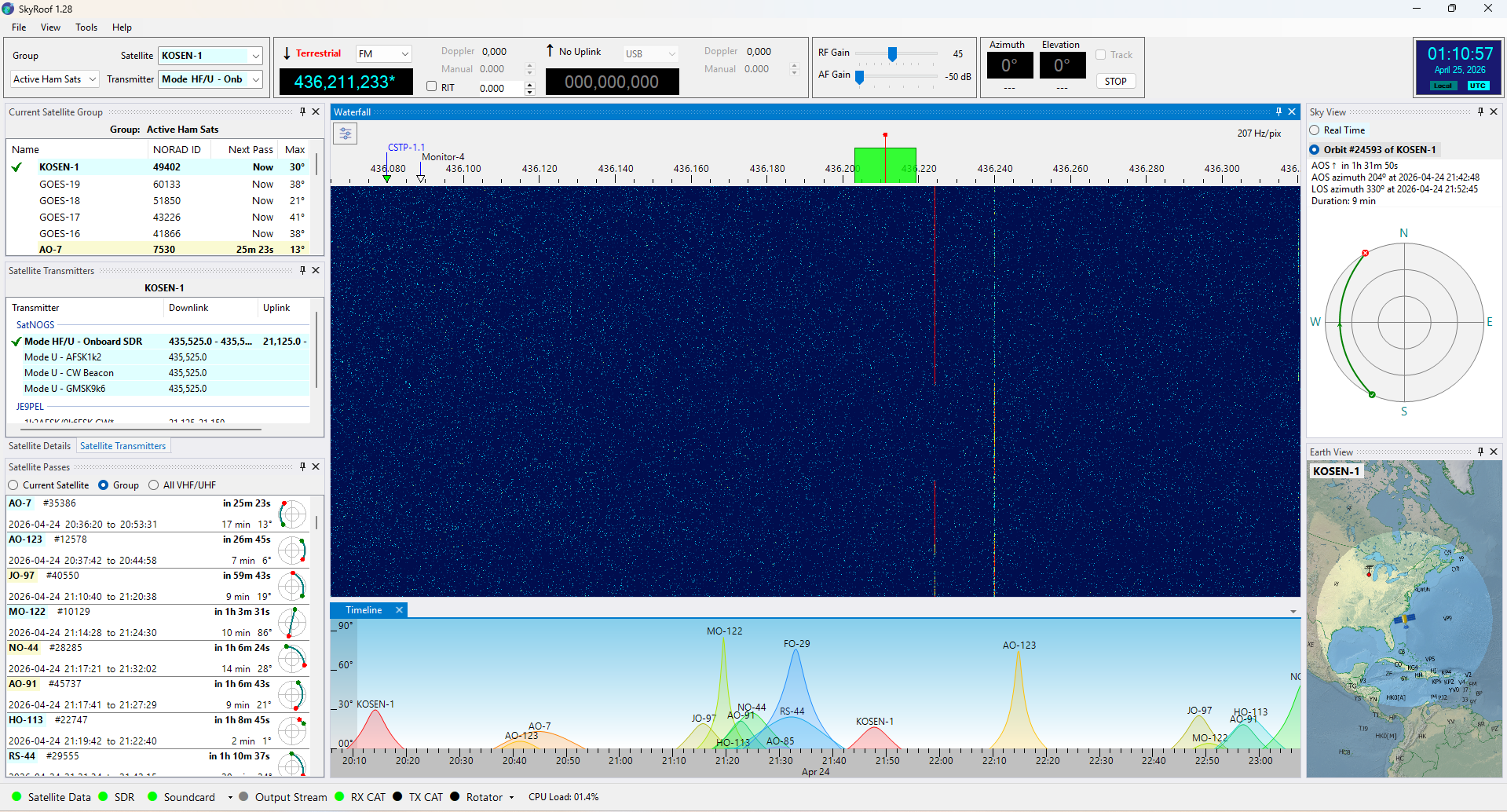
You need to know when a satellite is up and where to point — and ideally let the computer chase the Doppler. One program does all of it beautifully:
SkyRoof (by VE3NEA) is an excellent, free, open-source Windows app that combines satellite tracking and an SDR receiver in one window: a sky map, pass predictions, a live waterfall, automatic Doppler-corrected SSB/CW/FM demodulation, and even spoken AOS/LOS (“acquisition / loss of signal”) announcements. It works with RTL-SDR, Airspy and SDRplay, and can drive a rotator over Hamlib. If you’re getting started, it’s the easiest way to actually see and hear the birds.
Other solid options: Gpredict (cross-platform tracking), SatPC32 (the long-time standard for Doppler + rotator control), and N2YO for quick tracking in a browser.
Heard your first satellite yet?
Pass times, antenna builds, and “did you hear that?” — bring it to #ham-radio.